

Each year, Boomerang awards $50,000 to a research team pursuing an early-stage, high-potential idea that shows promise for carbon capture. Our goal is simple: help more potential “big swings” get out of the lab, generate the evidence needed for later-stage funding, and push the frontier of climate-impact technologies forward. These early steps often determine whether a concept survives long enough to scale, and we’ve made it our mission to help catalyze that journey.
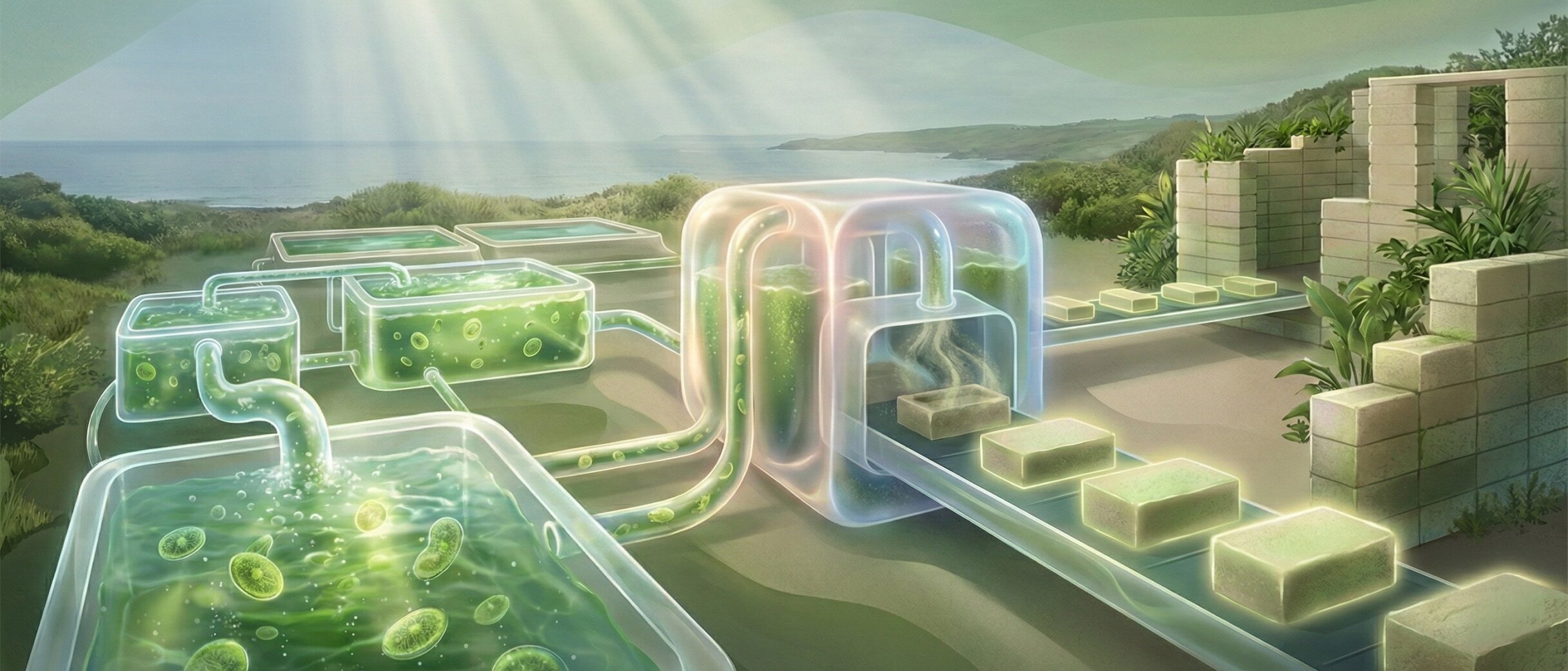
On this Giving Tuesday, we’re excited to announce that our 2025 funding has been awarded to the lab led by Dr. Gregory Rorrer, Professor in the School of Chemical, Biological, and Environmental Engineering at Oregon State University. His team is pursuing a novel approach to carbon sequestration through the production of “photosynthetic cement” by marine algae. This shows promise for manufacturing a usable building material out of the carbon that’s removed from the atmosphere while simultaneously avoiding the emissions created by producing conventional cement.
Turning CO₂ into a building material with algae
Long before humans grappled with atmospheric carbon, nature developed its own large-scale sequestration system. Tiny, single-celled algae called coccolithophores convert dissolved CO₂ into calcite shells. These shells make up 25–50% of their dry mass. Though each individual organism is microscopic, these algae have been so numerous at times throughout our planet’s history that their mass is evident in earth’s geology. The iconic white “Cliffs of Dover,” for example, are made almost entirely from ancient coccolithophore shells.
Dr. Rorrer’s proposal builds on this natural process. His team aims to cultivate coccolithophores, using sunlight, seawater, and air to turn CO₂ into mineral-rich algal biomass, but that’s not all. His proposal caught our attention because he proposes using this calcite-rich biomass into a solid, brick-like building material the team calls ‘Photosynthetic Cement’.
If successful, the process could simultaneously capture carbon, store it in stable mineral form, and produce a usable construction material, all while relying on abundant, low-impact inputs.
Why this research matters
Photosynthetic Cement would represent a rare triple win:
- Air-capture of CO₂ using a naturally evolved, energy-efficient biological process
- Stable sequestration as a usable building material
- Reduced reliance on conventional cement, which is produced through an energy-intensive, carbon-emitting process
To meaningfully slow climate change, the world needs a toolbox of carbon-removal solutions. The most promising of these solutions won’t only reduce the concentration of CO₂ in the air, but also produce some type of product that can be put to further use. Better yet, Dr. Rorrer’s product could further reduce other carbon emissions by reducing the need for cement created by today’s energy-intensive production methods — a major source of atmospheric greenhouse gasses. In 2023, global emissions from cement production were 1.56 billion metric tons of CO2. Breakdown of emissions:
- Global percentage: Cement production is responsible for roughly 8% of total global carbon dioxide emissions, making it one of the largest industrial emitters.
- Production volume: Globally, over 4 billion metric tons of cement are produced each year.
- Emission per ton: Manufacturing one ton of cement typically generates about 0.8 to 0.9 tons of CO2.
We’re excited to support Dr. Rorrer and his team as they explore the potential of algae-based carbon capture and carbon-negative construction materials. Their creativity, scientific rigor, and willingness to pursue an unconventional solution epitomize the spirit of this funding program. And we are grateful to all the researchers who applied but whom we weren’t able to select. Your ideas inspire us, and we hope to support more breakthrough work in the years to come.
Supporting primary education in Burma
In addition to our funding for carbon capture research, we are proud to once again support Build a School in Burma this year. We’ve partnered with Build a School in Burma nearly every year Boomerang has been able to and helped to provide educational facilities for thousands of children and families. Their devotion to this mission has resulted in life-changing outcomes for the students and their communities
As always, we are grateful to our subscribers. Your support allows us to do what we love — building software that saves time for its users — while investing a portion of the proceeds in these important causes. We couldn’t do it without you!